Avinguda Exèrcit 35-37
25194 Lleida
Spain
25194 Lleida
Spain

IASO’s foam covers — also known as thermal foam pool covers — create a floating barrier that significantly reduces evaporation, helps maintain the water temperature and lowers the use of chemical products. Lightweight, custom-made and easy to handle with a roller, they are an efficient solution for both residential and professional pools.
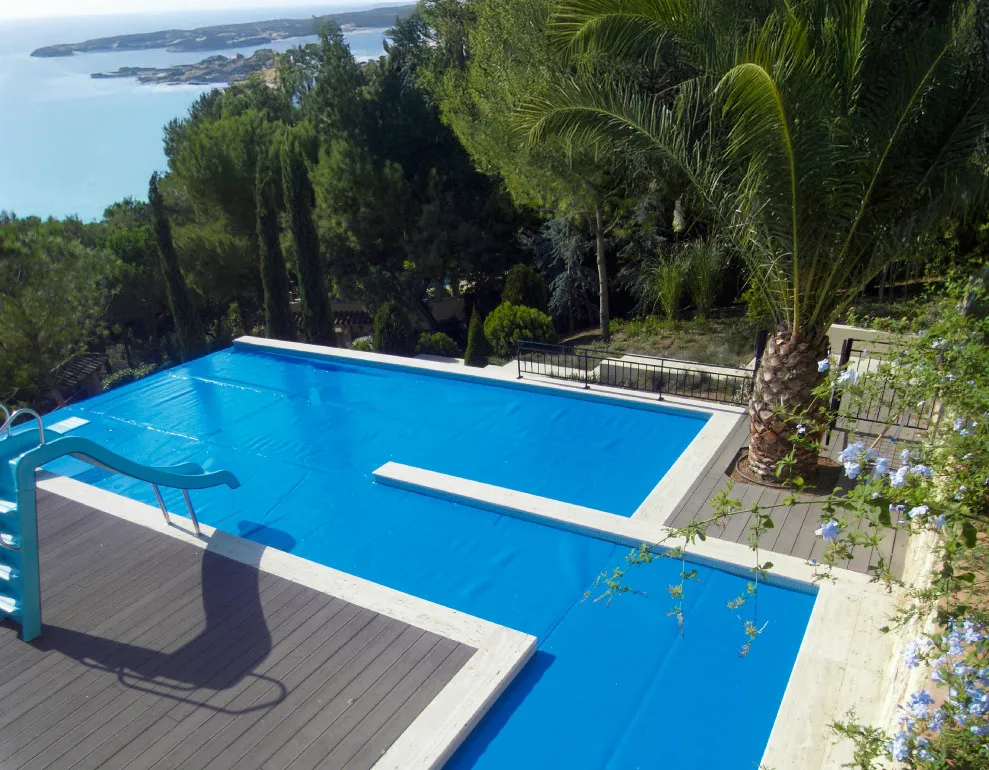
A foam cover is a closed-cell foam sheet that floats and acts as an insulator. By reducing evaporation — the main source of energy loss — it retains heat and stabilises the climate (especially indoors); outdoors, it protects from dirt and radiation and allows for longer use. It is custom-made for any geometry and operated with manual or motorised rollers; it can include reinforced edges, eyelets or towing strips. The material resists chlorine, salt and UV, and is cleaned with water and neutral detergent. It is not a child-safety system nor a perimeter enclosure. It reduces heating and maintenance costs (less make-up water and disinfectants) and, due to its light weight, is suitable for hotels, sports centres, spas and homes. Related products: rollers, automatic slatted covers and winter pool covers to complete the solution depending on the season.
Discover how our innovative solutions transform spaces and enhance experiences. Stories that inspire and showcase the essence of IASO in every project.

IASO’s new website has been awarded at the CSS Design Awards with recognitions in the UI, UX and Innovation categories, an international prize that distinguishes digital projects for their design quality, user experience and innovation.
At REBUILD 2026, IASO presented a new range of modular structures within its Textile Architecture line. The proposal responds to an increasingly common need in many projects: to create shade, protection and outdoor comfort with lightweight, adaptable and easy-to-install solutions.
More than a catalogue launch, this presentation represents a different way of bringing textile architecture to a wide variety of spaces and uses. A clearer way to understand how a lightweight roof can organise an environment, improve its habitability and expand its potential uses without resorting to heavy or visually invasive systems.