

Where to start: the key questions before buying
Before looking through catalogues, it is worth answering six basic questions. They apply to both domestic and professional use and help avoid the most common mistake: buying an attractive umbrella that does not suit the space or its real use.
- Where will it be installed? Garden, terrace, balcony, swimming pool, bar terrace, rooftop, campsite pitch…
- What surface area needs to be covered? A table for 4, a chill-out area, 20 restaurant tables…
- What is the orientation and dominant sun exposure? South-facing (vertical sun in summer), east/west-facing (low-angle sun)…
- What wind conditions are common? Wind resistance determines the structure and base.
- What type and intensity of use will it have? Occasional domestic use, daily residential use, intensive professional use (hospitality, hotel)…
- What budget and payback horizon are you working with? A B2C umbrella is considered over 5-10 years; a B2B umbrella over 8-15 years.
Types of umbrella and when to choose each one
There are five main types of umbrella that cover practically every use case. Understanding them is the first step towards choosing well.
Central-pole umbrella
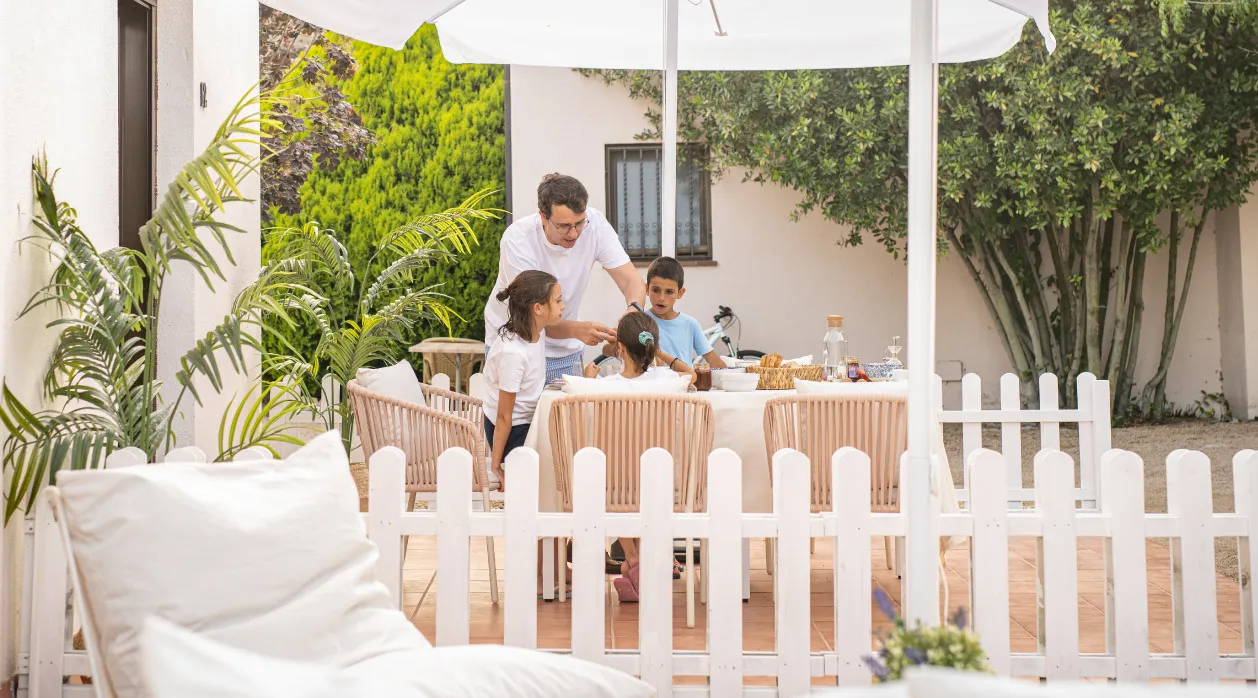
The classic option: pole in the centre, fabric above. Economical, easy to move and removable. It is the most suitable option for occasional domestic use, small terraces and dining areas. Limitation: the base takes up space under the shade.
Cantilever or side-arm umbrella
The canopy hangs from a side arm, leaving the entire shaded area free. Ideal for chill-out areas, outdoor sofas, by the swimming pool or over sun loungers. It is more expensive and requires a very heavy base or floor anchoring.
Wall-mounted umbrella
It is fixed to a façade or wall using a folding support. An optimum solution for narrow terraces, balconies and penthouses where floor space is limited. It requires a façade with sufficient structural capacity.
Professional umbrella for hospitality
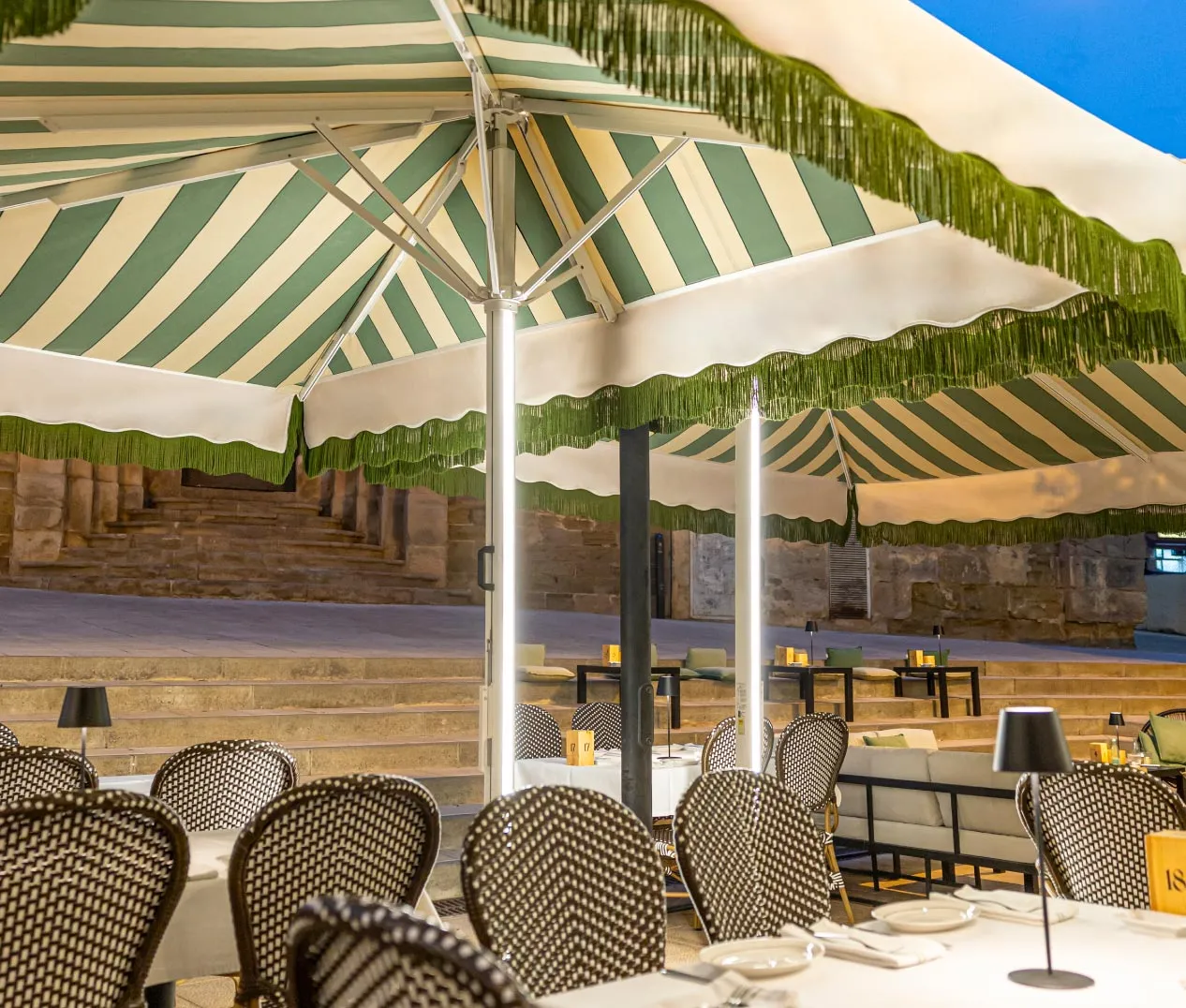
A reinforced version of the classic or cantilever umbrella, with a more robust structure, certified fabrics for intensive use and customisation options (logos, corporate colours). Designed to be opened and closed dozens of times a day.
Small pergola or technical sunshade
Halfway between an umbrella and a pergola. A fixed structure (sometimes with adjustable louvres or a retractable cover) that covers larger areas. Its installation is similar to a minor works project, but its durability and performance are much higher.
Size and coverage
One of the most searched questions is what size umbrella to choose. The practical rule is simple: the umbrella should extend beyond the area to be shaded by between 50 and 100 cm on each side, because the actual shade moves throughout the day.
As a reference, a square 2 x 2 m umbrella comfortably covers a table for 4 people; a 3 x 3 m umbrella covers a table for 6-8 people or a garden sofa; and from 3.5 x 3.5 m or 4 x 4 m upwards, we enter the professional range or large chill-out areas. For hospitality, the usual approach is to group modular 3 x 3 or 4 x 4 m umbrellas that work together to cover complete terraces.
A useful tip for south-facing orientation: because the sun is higher, a square surface provides better coverage; for east/west-facing orientations, a larger or rectangular umbrella is advisable, as the sun enters at a lower angle.
Fabrics: UV protection, durability and opacity
The fabric is what most clearly separates a cheap umbrella from a durable one. Three key parameters:
→ UV protection: a quality umbrella should provide UPF 50+, which means blocking more than 98% of ultraviolet radiation. For use with children or swimming pools, this data is essential.
→ Fabric composition: the main options are polyester (economical, 3-5-year service life), solution-dyed acrylic (mid-to-high range, 8-12 years, fade-resistant) and olefin or technical fabrics (high-end, maximum resistance to UV, stains and mould).
→ Weight: measured in g/m², it determines opacity and resistance. Below 200 g/m², these are lightweight fabrics (occasional use); 240-300 g/m² is the quality standard; above 300 g/m², we enter the professional range.
For hospitality, it is also important for the fabric to be fire-resistant, a requirement set by many insurers and local regulations.
Structure and mechanisms: aluminium, wood and opening systems
The structure defines the real durability and user experience. The most common options are aluminium (lightweight, rust-free, low maintenance, ideal for coastal areas), hardwood such as bamboo, eucalyptus or teak (warm aesthetic, but requires periodic treatment) and steel or fibreglass in professional umbrellas that need maximum rigidity.
As for the mechanism, the main options are: crank handle (simple, economical, reliable), pulley or rope (classic for pole umbrellas), push-up opening (lightweight, for beach format or small terraces) and, in the professional range, systems with a winding mechanism or electric motor for large cantilever umbrellas. For intensive use, robust mechanisms should be prioritised: a hospitality umbrella can be opened and closed more than 1,000 times a year, and cheap mechanisms will not withstand this.
Bases and anchors
The base is, together with the fabric, one of the main causes of failure. A poorly anchored umbrella is a safety risk. As a general rule, the recommended base weight depends on the umbrella size and type:
For a central-pole umbrella measuring 2 x 2 m, 25-30 kg is sufficient; a 3 x 3 m model needs 50-60 kg; and a 4 x 4 m model requires 80 kg or more. For cantilever umbrellas, the figure should always be doubled: from 3 x 3 m upwards, less than 100-120 kg is not recommended, ideally with a cement-filled base or floor anchoring. For permanent professional use, the correct approach is to anchor directly to the floor using a bolted plate or a bushing embedded in concrete.
Wind resistance and regulations
European umbrellas are governed by the UNE-EN 13561 standard, which classifies wind resistance into four classes (0 to 3) according to the maximum speed withstood with the umbrella open. The approximate equivalence with the Beaufort scale is:
| EN 13561 class | Max. speed | Beaufort / context |
|---|---|---|
| Class 0 | < 27 km/h | Light breeze (3 Bft) — basic domestic use |
| Class 1 | < 38 km/h | Moderate breeze (5 Bft) — urban terraces |
| Class 2 | < 49 km/h | Fresh wind (6 Bft) — hospitality, coastal areas |
| Class 3 | < 62 km/h | Strong wind (7 Bft) — high exposure, professional use |
The practical rule is always the same: when in doubt about wind, close the umbrella. An open umbrella in adverse conditions becomes a sail and can drag even heavy bases.
How to choose an umbrella for domestic use
For a private user, the decision criteria are ordered as follows: real use, available space, aesthetics and budget. A well-chosen B2C umbrella has a 5-10-year horizon and is usually used seasonally.
For urban terraces and balconies
The surface area is usually small and floor space is limited. The best option is often a wall-mounted umbrella or a central-pole umbrella measuring 2 x 2 or 2.5 x 2.5 m with a discreet base. Important: check the regulations of the homeowners’ association and your local council; many municipalities regulate colours and elements visible from the street.
For gardens and chill-out areas
This is where the cantilever umbrella measuring 3 x 3 or 3.5 x 3.5 m stands out: it leaves the entire shaded area free, can be reoriented throughout the day and looks excellent. Always combine it with a heavy base or anchor it to the floor.
For private swimming pools
Prioritise fabrics that are resistant to chlorine and humidity (solution-dyed acrylic or olefin) and an aluminium structure to prevent corrosion. If children will be using the area, require certified UPF 50+ protection.
For occasional use or second homes
A lightweight, folding and easy-to-store umbrella is better than a technical model that will be left abandoned in the sun. Economical polyester fabrics are perfectly valid if use is sporadic.
How to choose an umbrella for hospitality and business use
In the professional field, the criteria change radically. The question is not only which umbrella do I like, but which umbrella pays back the investment, does not generate incidents and reinforces the brand. A B2B umbrella is considered over an 8-15-year service life and must withstand intensive use.
Durability and intensive use
Reinforced aluminium or steel structure, mechanisms certified for repeated opening/closing cycles and fabrics with a weight above 280 g/m². The domestic range does not withstand bar or restaurant use: what appears to be an initial saving turns into replacements every 2-3 years.
Customisation and branding
A hospitality umbrella often includes a logo, corporate colours and printed valances. It is a powerful advertising support and, when properly managed, reinforces the establishment’s brand image. Always request fabric samples and a prior visual simulation from the manufacturer.
Regulations, insurance and certifications
For hospitality, it is advisable to require: UNE-EN 13561 (wind resistance), fire classification (M1, M2 or equivalent European classifications) and fabric certifications (UPF 50+, UV resistance). On rooftops and penthouses, anchoring calculations must be carried out by a technician with professional liability cover.
Coverage per m² and modularity
For a hotel or restaurant terrace, plan coverage through modular units (aligned 3 x 3 or 4 x 4 m umbrellas) that complement each other without leaving unshaded areas. The ideal coverage is 80-90% of the usable surface area, leaving space around the edges for movement and evacuation.
Scheduled maintenance
A B2B umbrella without a maintenance plan is a future fault waiting to happen. The recommendation is to arrange an annual technical inspection (mechanisms, anchors, fabric) and professional cleaning twice a year, in addition to daily care by the establishment’s staff.
Camping, glamping and tourist areas
In camping, ease of installation and replacement, resistance to rural or coastal environments and the possibility of special anchors in soft ground are especially important. For glamping and boutique hotels, aesthetics matter almost as much as durability: umbrellas made from hardwood with natural fabrics are often the preferred choice.
Common mistakes when choosing an umbrella
Before making the final decision, it is worth reviewing the most frequent mistakes. The most common is choosing the size according to the furniture rather than the actual surface area to be covered: shade moves, so an umbrella that is just large enough will fall short from around 14:00 or 16:00 onwards. Another classic mistake is undersizing the base: saving €30-50 on the base can ruin a €500 umbrella with the first gust of wind.
It is also very common to buy a domestic umbrella for professional use, assuming it will withstand the workload. It will not: what appears to be a saving becomes replacements every two seasons. Conversely, a private user who buys a professional 4 x 4 m umbrella for a 6 m² terrace is paying more than necessary. Finally, ignoring local regulations (homeowners’ association, local council, hospitality rules) may force you to remove a newly purchased umbrella: always check before buying, not afterwards.
Frequently asked questions about how to choose an umbrella
What size umbrella do I need?
The practical rule is that the umbrella should extend beyond the area to be covered by 50 to 100 cm on each side, because the shade moves throughout the day. A 2 x 2 m umbrella covers a table for 4 people; a 3 x 3 m model covers a table for 6-8 people or a sofa; from 4 x 4 m upwards, we are already talking about professional use or large chill-out areas.
Which is better: a central-pole or cantilever umbrella?
It depends on the use. The central-pole umbrella is more economical, lighter and portable, ideal for occasional domestic use. The cantilever umbrella leaves the entire shaded area free and is perfect for chill-out areas, next to swimming pools or over sun loungers, but it requires a very heavy base or floor anchoring.
Which fabric should I choose for a durable umbrella?
For standard domestic use, solution-dyed acrylic with UPF 50+ and a weight of 240-280 g/m² offers the best value for money. For hospitality or demanding environments, it is advisable to choose olefin or fire-retardant technical fabrics with a weight above 280 g/m².
How much should an umbrella base weigh?
As a general reference: 25-30 kg for a 2 x 2 m umbrella, 50-60 kg for a 3 x 3 m umbrella and 80 kg or more for a 4 x 4 m umbrella. For cantilever umbrellas, the weight must be doubled, and for permanent professional use the correct approach is to anchor directly to the floor.
What wind resistance should an umbrella have?
The UNE-EN 13561 standard classifies umbrellas into four classes. Class 1 (up to 38 km/h) is suitable for basic domestic use; Class 2 (up to 49 km/h) for urban terraces and coastal areas; and Class 3 (up to 62 km/h) for hospitality or high exposure. In any case, when in doubt about wind, the safe option is to close the umbrella.
What is the difference between a domestic and a professional umbrella?
A professional hospitality umbrella uses a more robust structure (reinforced aluminium or steel), fabrics with a higher weight and fire certification, mechanisms designed for intensive use and usually allows customisation with logos and corporate colours. The investment is 3 to 5 times higher, but so is the service life.
Do I need permission to install an umbrella?
For domestic use in a private garden, usually not, but on balconies and terraces in homeowners’ associations, authorisation is often required (community statutes). On hospitality terraces on public roads, the local council regulates dimensions, colour and safety standards. It is advisable to check local regulations before buying.
How do I choose an umbrella for a hotel or restaurant terrace?
For hospitality, prioritise durability (reinforced aluminium structure, fabrics > 280 g/m²), regulations (UNE-EN 13561 Class 2 or 3, fire classification), modularity (3 x 3 or 4 x 4 m umbrellas covering 80-90% of the terrace) and customisation with branding. Always plan annual maintenance.